
[First lines:]
I have never been able to feel for Charles Lamb the
affection that he inspires in most of his readers. There is a cross grain in my
nature that makes me resent the transports of others and gush will dry up in me
(against my will, for heaven knows I have no wish to chill by my coldness the
enthusiasm of my neighbours) the capacity of admiration. Too many critics have
written of Charles Lamb with insipidity for me ever to have been able to read
him without uneasiness. He is like one of those persons of overflowing heart
who seem to lie in wait for disaster to befall you so that they may envelop you
with their sympathy. Their arms are so quickly outstretched to raise you when
you fall that you cannot help asking yourself, as you rub your barked shin, whether
by any chance they did not put in your path the stone that tripped you up. I am
afraid of people with too much charm. They devour you. In the end you are made
a sacrifice to the exercise of their fascinating gift and their insincerity. Nor
do I much care for writers whose charm is their chief asset. It is not enough.
I want something to get my teeth into, and when I ask for roast beef and
Yorkshire pudding I am dissatisfied to be given bread and milk. I am put out of
countenance by the sensibility of the Gentle Elia. For a generation Rousseau had
pinned every writer’s heart to his sleeve and it was in his day still the
fashion to write with a lump in the throat, but Lamb’s emotion, to my mind, too
often suggests the facile lachrymosity of the alcoholic. I cannot but think his
tenderness would have been advantageously tempered by abstinence, a blue pill
and a black draught. Of course when you read the references made to him by his
contemporaries, you discover that the Gentle Elia is an invention of the
sentimentalists. He was a more robust, irascible and intemperate fellow than
they have made him out, and he would have laughed (and with justice) at the
portrait they have painted of him. If you had met him one evening at Benjamin
Haydon’s, you would have seen a grubby little person, somewhat the worse for
liquor, who could be very dull, and if he made a joke it might as easily have
been a bad as a good one. In fact, you would have met Charles Lamb and not the
Gentle Elia. And if you had read that morning one of his essays in The London Magazine you would have
thought it an agreeable trifle. It would never have occurred to you that this
pleasant piece would serve one day as a pretext for the lucubrations of the
learned. You would have read it in the right spirit; for you it would have been
a living thing. It is one of the misfortunes to which the writer is subject that
he is too little praised when he is alive and too much when he is dead. The
critics force us to read the classics as Machiavelli wrote, in Court dress; whereas
we should do much better to read them, as though they were our contemporaries,
in a dressing-gown.
And because I had read Lamb in deference to common
opinion rather than from inclination I had forborne to read Hazlitt at all. What
with the innumerable books it urgently imported me to read, I came to the
conclusion that I could afford to neglect a writer who had but done mediocrely
(I understood) what another had done with excellence. And the Gentle Elia bored
me. It was seldom I had read anything about Lamb without coming across a fling
and a sneer at Hazlitt. I knew that FitzGerald had once intended to write a
life of him, but had given up the project in disgust of his character. He was a
mean, savage, nasty little man and an unworthy hanger-on of the circle in which
Lamb, Keats, Shelley, Coleridge and Wordsworth shone with so bright a lustre. There
seemed no need to waste any time on a writer of so little talent and of so
unpleasant a nature. But one day, about to start on a long journey, I was
wondering round Bumpus’s looking for books to take with me when I came across a
selection of Hazlitt’s Essays. It was an agreeable little volume in a green
cover, and nicely printed, cheap in price and light to hold, and out of
curiosity to know the truth about an author of whom I had read so much ill, I
put it on the pile that I had already collected.
[Chapter II:]
I began to read my Hazlitt. I was astonished. I found
a solid writer, without pretentiousness, courageous to speak his mind, sensible
and plain, with a passion for the arts that was neither gushing nor forced,
various, interested in the life about him, ingenious, sufficiently profound for
his purposes, but with no affectation of profundity, humorous, sensitive. And I
liked his English. It was natural and racy, eloquent where eloquence was
needed, easy to read, clear and succinct, neither below the weight of his
matter nor with fine phrases trying to give it a specious importance. If art is
nature seen through the medium of a personality, Hazlitt is a great artist.
I was enraptured. I could not forgive myself that I
had lived so long without reading him and I raged against the idolaters of Elia
whose foolishness had deprived me till now of so vivid an experience. Here
certainly was no charm, but what a robust mind, sane, clear-cut and vivacious,
and what vigour! Presently I came across the rich essay which is entitled On Going A Journey and I reached the
passage that runs: ‘Oh! it is great to shake off the trammels of the world and
of public opinion – to lose our importunate, tormenting, everlasting personal
identity in the elements of nature, and become the creature of the moment,
clear of all ties – to hold to the universe only by a dish of sweet-breads, and
to owe nothing but the score of the evening – and no longer seeking for
applause and meeting with contempt, to be known by no other title than The Gentleman in the Parlour!’ I could
wish that Hazlitt had used fewer dashes in this passage. There is in the dash
something rough, ready and haphazard that goes against my grain. I have seldom
read a sentence in which it could not be well replaced by the elegant semi-colon
or the discreet bracket. But I had no sooner read these words than it occurred
to me that here was an admirable name for a book of travel and I made up my
mind to write it.
[Chapter IV:]
So that the reader of these pages may be under no
misapprehension I hasten to tell him that he will find in them little
information. This book is a record of a journey through Burmah, the Shan
States, Siam and Indo-China. I am writing it for my own diversion and I hope
that it will divert also such as care to spend a few hours in reading it. I am
a professional writer and I hope to get from it a certain amount of money and
perhaps a little praise.
[Chapter X = “Masterson”:]
Often in some lonely post in the jungle or in a stiff
grand house, solitary in the midst of a teeming Chinese city, a man has told me
stories about himself that I was sure he had never told to a living soul. I was
a stray acquaintance whom he had never seen before and would never see again, a
wanderer for a moment through his monotonous life, and some starved impulse led
him to lay bare his soul. I have in this way learned more about men in a night
(sitting over a syphon or two and a bottle of whisky, the hostile, inexplicable
world outside the radius of an acetylene lamp) than I could have if I had known
them for ten years. If you are interested in human nature it is one of the
great pleasures of travel.
[Chapter XIII:]
The lot of the English and the American humorist is
hard, for pornography rather than brevity is the soul of wit, but the
prudishness of his audience (and perhaps their sentimentality) has forced him
to look for a laugh everywhere but where it is most easily found. But just as
the poet may beat out more exquisite verse when he is constrained by the complicated
measures of a Pindaric ode than when he has the elbow room of blank verse, so
the difficulties placed in the way of our humorists have often resulted in
their making unexpected discoveries in the ludicrous. They have found a rich
load of laughter where but for the taboos they would never have sought it. The
two pitfalls that threaten the humorist are the inane on one side and the
disgusting on the other; and it is a regrettable fact, which the English or
American humorist has to put up with, that the inane enrages more than the
disgusting revolts.
[Chapter XV:]
And suddenly I came upon a tiny village; it consisted
of no more than four or five houses surrounded by a stockade of bamboos. I was
as surprised to find it there, right in the jungle and six or seven miles from
the main road, as its inhabitants must have been to see me, but neither they
nor I would betray by our demeanour that there was anything odd about it. […] I
wondered how those people had found their way there and what they did; they
were self-subsistent, living a life entirely of their own, and as much cut off
from the outside world as though they dwelt on an atoll in the South Seas. I
knew and could know nothing of them. They were as different from me as though
they belonged to another species. But they had passions like mine, the same
hopes, the same desires, the same griefs. To them too, I suppose, love came
like sunshine after rain, and to them too, I suppose, came satiety. But for
them the days unchanging added their long line to one another without haste and
without surprise; they followed their appointed round and led the lives their
fathers had led before them. The pattern was traced and all they had to do was
to follow it. Was that not wisdom and in their constancy was there not beauty?
[Chapter XXI:]
We are gregarious, most of us, and we resent the man
who does not seek the society of his fellows. We do not content ourselves with
saying that he is odd, but we ascribe to him unworthy motives. Our pride is
wounded that he should have no use for us and we nod to one another and wink
and say that if he lives in this strange way it must be to practise some secret
vice and if he does not inhabit his own country it can only be because his own
country is too hot to hold him. But there are people who do not feel at home in
the world, the companionship of others is not necessary to them and they are
ill-at-east amid the exuberance of their fellows. They have an invincible
shyness. Shared emotions abash them. The thought of community singing, even though
it be but God Save the King, fills
them with embarrassment, and if they sing it is plaintively in their baths. They
are self-sufficient and they shrug a resigned and sometimes, it must be
admitted, a scornful shoulder because the world uses that adjective in a
depreciatory sense. Wherever they are they feel themselves ‘out of it’. They
are to be found all over the surface of this earth, members of a great monastic
order bound by no vows and cloistered though not by walls of stone. If you
wander up and down the world you will meet them in all sorts of unexpected
places. You are not surprised when you hear that an elderly English lady is living
in a villa on a hill outside a small Italian town that you have happened on by
an accident to the car in which you were driving, for Italy Andalusia and you are told that there has dwelt for many
years an English lady of a certain age. She is usually a devout Catholic and
sometimes lives in sin with her coachman. But it is more surprising when you
hear that the only white person in a Chinese city is an Englishwoman, not a
missionary, who has lived there, none knows why, for a quarter of a century;
and there is another who inhabits an islet in the South Seas and a third who
has a bungalow on the outskirts of a large village in the centre of Java. They
live solitary lives, without friends, and they do not welcome the stranger. Though
they may not have seen one of their own race for months they will pass you on
the road as though they did not see you, and if, presuming on your nationality,
you call, the chances are that they will decline to receive you; but if they do
they will give you a cup of tea from a silver tea-pot and on a plate of old
Worcester you will be offered hot scones. They will talk to you politely, as
though they were entertaining you in a drawing-room overlooking a London
The men are at once shyer and more friendly. At first
they are tongue-tied and you see the anxious look on their faces as they rack
their brains for topics of conversation, but a glass of whiskey loosens their
minds (for sometimes they are inclined to tipple) and then they will talk
freely. They are glad to see you, but you must be careful not to abuse your
welcome; they get tired of company very soon and grow restless at the necessity
of making an effort. They are more apt to run to seed than women, they live in
a higgledy-piggledy manner, indifferent to their surroundings and their food. They
have often an ostensible occupation. They keep a little shop, but do not care
whether they sell anything, and their goods are dusty and fly-blown; or they
run, with lackadaisical incompetence, a coconut plantation. They are on the
verge of bankruptcy. Sometimes they are engaged in metaphysical speculation, and
I met one who had spent years in the study and annotation of the works of
Immanuel Swedenborg. Sometimes they are students and take endless pains to
translate classical works which have been already translated, like the
dialogues of Plato, or of which translation is impossible, like Goethe’s Faust. They may not be very useful
members of society, but their lives are harmless and innocent. If the world
despises them they on their side despise the world. The thought of returning to
its turmoil is a nightmare to them. They ask nothing but to be left in peace. Their
satisfaction with their lot is sometimes a trifle irritating. It needs a good
deal of philosophy not to be mortified by the thought of persons who have voluntarily
abandoned everything that for the most of us makes life worth living and are
devoid of envy of what they have missed. I have never made up my mind whether
they are fools or wise men. They have given up everything for a dream, a dream
of peace or happiness or freedom, and their dream is so intense that they make
it true.
[Chapter XXX:]
Most of the gods that the world has seen have made a
somewhat frantic claim that men should have faith in them, and have threatened
with dreadful penalties such as could not (whatever their goodwill) believe. There
is something pathetic in the violence with which they denounce those who thwart
them in the bestowal of the great gifts they have to offer. They seem deep in
their hearts to have felt that it was the faith of others that gave them
divinity (as though their godhead standing on an insecure foundation every
believer was as it were a stone to buttress it) and that the message they so ardently
craved to deliver could only have its efficacy if they became god. And god they
could only become if men believed in them. But Gautama made only the claim of
the physician that you should give him a trial and judge him by results. He was
more like the artist who does his work as best he can because to produce art is
his function, and having offered his gift such modifications as were rendered necessary
by his disbelief in the soul. For as everyone knows the most important point of
the Buddha’s teaching was that there was no such thing as a soul or a self. Every
person is a putting together of qualities, material and mental; there can be no
putting together without a becoming different, and there can be no becoming
different without a passing away. Whatever has a beginning also has an end. The
thought is exhilarating like a brisk winter morning when the sun shines and the
road over the Downs is springy under the feet.
Karma (I venture to remind the reader) is the theory that a man’s actions in one
existence determine his fate in the next. At death under the influence of the
desire of life the impermanent aggregation of qualities which was a man
reassembles to form another aggregation as impermanent. He is merely the
present and temporary link in a long chain of cause and effect. The law of
Karma prescribes that every act must have its result. It is the only
explanation of the evil of this world that does not outrage the heart.
[…]
Now it happened that one of the books I had brought to
read on the way was Bradley’s Appearance
and Reality. I had read it before, but had found it difficult and wanted to
read it again, but since it was an unwieldy volume I tore off the biding and
divided it into sections that I could conveniently put in my pocket when,
having read enough, I mounted my pony and rode off from the bungalow in which I
had passed the night. It is good reading, and though it scarcely convinces you
it is often caustic, and the author has a pleasant gift of irony. He is never
pompous. He handles the abstract with a light touch. But it is like one of
those cubist houses in an exhibition, very light and trim and airy, but so
severe in line and furnished with such austere taste, that you cannot imagine yourself
toasting your toes by the fire and lounging in an easy chair with a comfortable
book. But when I came upon his treatment of the problem of evil I found myself
as honestly scandalised as the Pope at the sight of a young woman’s shapely
calves. The Absolute, I read, is perfect, and evil, being but an appearance, cannot
but subserve to the perfection of the whole. Error contributes to greater
energy of life. Evil plays a part in a higher end and in this sense unknowingly
is good. The absolute is richer for every discord. And my memory brought back
to me, I know not why, a scene at the beginning of the war. It was in October
and our sensibilities were not yet blunted. A cold raw night. There had been what
those who took part in it thought a battle, but which was so insignificant a
skirmish that the papers did not so much as refer to it, and about a thousand
men had been killed and wounded. They lay on straw on the floor of a country
church, and the only light came from the candles on the altar. The Germans were
advancing and it was necessary to evacuate them as quickly as possible. All
through the night the ambulance cars, without lights, drove back and forth, and
the wounded cried out to be taken, and some died as they were being lifted on
to the stretchers and were thrown on the heap of dead outside the door, and
they were dirty and gory, and the church stank of blood and the rankness of
humanity. And there was one boy who was so shattered that it was not worth
while to move him and as he lay there, seeing men on either side of him being
taken out, he screamed at the top of his voice: je ne veux pas mourir. Je
suis trop jeune. Je ne veux pas mourir. And he went on screaming that he
did not want to die till he died. Of course this is no argument. It was but an
inconsiderable incident the only significance of which was that I saw it with
my own eyes and in my ears for days afterwards rang that despairing cry; but a
greater than I, a philosopher and a mathematician into the bargain if you
please, said that the heart had its reasons which the head did not know, and
(in the grip of compound things, to use the Buddhist phrase, as I am) this
scene is to me a sufficient refutation of the metaphysician’s fine-spun
theories. But my heart can accept the evils that befall me if they are the consequence
of actions that I (the I that is not my soul, which perishes, but the result of
my deeds in another state of existence) did in past time, and I am resigned to
the evils that I see about me, the death of the young (the most bitter of all)
the grief of the mothers that bore them in anguish, poverty and sickness and
frustrated hopes, if these evils are but the consequence of the sins which
those that suffer them once committed. Here is an explanation that outrages
neither the heart nor the head; there is only one fault that I can find in it:
it is incredible.
[Chapter XXXII = “Princess September”]
‘Then take your freedom,’ she said, ‘I shut you in a
golden cage because I loved you and wanted to have you all to myself. But I
never knew it will kill you. Go. Fly away among the trees that are round the
lake and fly over the green rice fields. I love you enough to let you be happy
in your own way.’
[…]
Then he opened his wings and flew right away into the
blue. But the little Princess burst into tears, for it is very difficult to put
the happiness of someone you love before your own, and with her little bird far
out of sight she felt on a sudden very lonely.
[Chapter XXXIV = “A Marriage of Convenience”:]
It appears that the Oriental has a passion for the
circus and Mr Wilkins for twenty years had been travelling up and down the East
from Port Said to Yokohama (Aden, Bombay, Madras, Calcutta, Rangoon, Singapore,
Penang, Bangkok, Saigon, Hue, Hanoi, Hong-Kong, Shanghai, their names roll on
the tongue savourily, crowding the imagination with sunshine and strange sounds
and a multicoloured activity) with his menagerie and his merry-go-rounds. It
was a strange life he led, unusual and one that, one would have thought, must
offer the occasion for all sorts of curious experiences, but the odd thing
about him was that he was a perfectly commonplace little man and you would have
been prepared to find him running a garage or keeping a third-rate hotel in a
second-rate town in California. The fact is, and I have noticed it so often that
I do not know why it should always surprise me, that the extraordinariness of a
man’s life does not make him extraordinary, but contrariwise if a man is extraordinary
he will make extraordinariness out of a life as humdrum as that of a country
curate. I wish I could feel it reasonable to tell here the story of the hermit
I went to see on an island in the Torres Straits, a shipwrecked mariner who had
lived there alone for thirty years, but when you are writing a book you are
imprisoned by the four walls of your subject and though for the entertainment
of my own digressing mind I set it down now I should be forced in the end by my
sense of what is fit to go between two covers and what is not, to cut it out. Anyhow,
the long and short of it is that notwithstanding this long and intimate
communion with nature and his thoughts the man was as dull, insensitive and vulgar
an oaf at the end of this experience as he must have been at the beginning.
[Last lines:]
‘The fact is that in a marriage of convenience you expect
less and so you are less likely to be disappointed. As you do not make
senseless claims on one another there is no reason for exasperation. You do not
look for perfection and so you are tolerant to one another’s faults. Passion is
all very well, but it is not a proper foundation for marriage. <i>Voyez-vous</i>,
for two people to be happy in marriage they must be able to respect one another,
they must be of the same condition and their interests must be alike; then if
they are decent people and are willing to give and take, to live and let live,
there is no reason why their union should not be as happy as ours.’ She paused.
‘But, of course, my husband is a very, very remarkable man.’
[Chapter XXXVI:]
But now that I come to this part of my book I am seized
with dismay. I have never seen anything in the world more wonderful than the
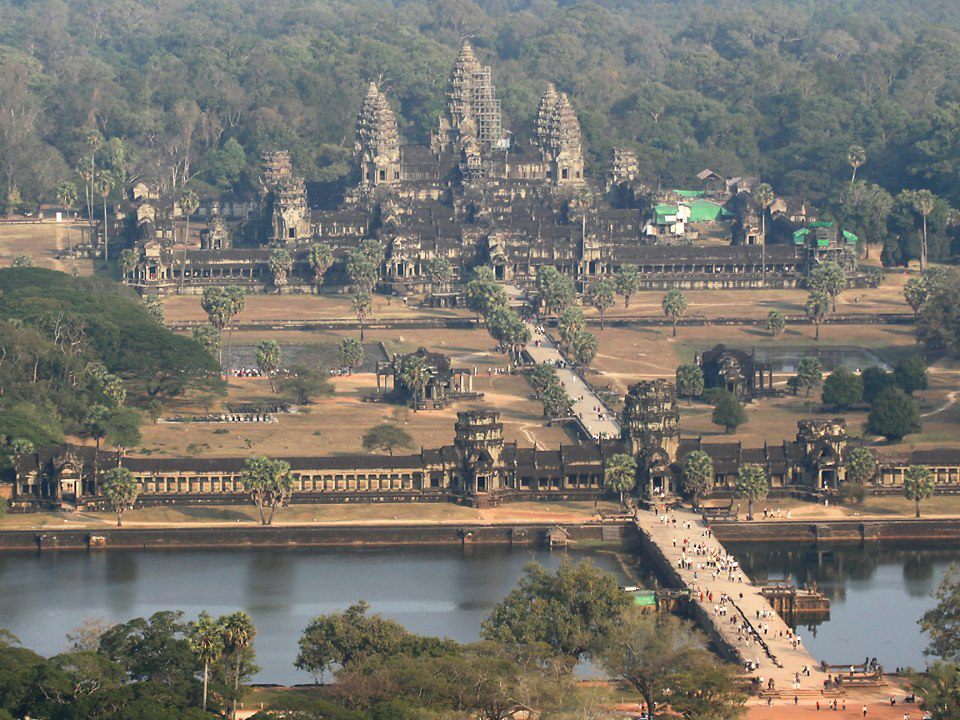
temples of Angkor , but I do not know how on
earth I am going to set down in black and white such an account of them as will
give even the most sensitive reader more than a confused and shadowy impression
of their grandeur. Of course to the artist in words, who takes pleasure in the
sound of them and their look on the page, it would be an opportunity in a
thousand. What a chance for prose pompous and sensual, varied, solemn and
harmonious; and what a delight to such a one it would be to reproduce in his
long phrases the long lines of the buildings, in the balance of his paragraphs to
express their symmetry, and in the opulence of his vocabulary their rich
decoration! It would be enchanting to find the apt word and by putting it in
its right place give the same rhythm to the sentence as he had seen in the
massed grey stones; and it would be a triumph to hit upon the unusual, the
revealing epithet that translated into another beauty the colour, the form and
the strangeness of what he alone had had the gift to see.
Alas, I have not the smallest talent for this sort of
thing, and – doubtless because I cannot do it myself – I do not very much like
it in others. A little of it goes a long way with me. […] I can bear it better
when this kind of stately writing is done by our forefathers. The grand style
became them. I am awed by the magnificence of Sir Thomas Browne; it is like
staying in a great Palladian palace with frescoes by Veronese on the ceilings
and tapestries on the walls. It is impressive rather than homely. You cannot
see yourself doing your daily dozen in those august surroundings.
[…]
…we do not write as we want to but as we can, and
though I have the greatest respect for those authors who are blessed with a
happy gift of phrase I have long resigned myself to writing as plainly as I
can. I have a very small vocabulary and I manage to make do with it, I am
afraid, only because I see things with no great subtlety. I think perhaps I see
them with a certain passion and it interests me to translate into words not the
look of them, but the emotion they have given me. But I am content if I can put
this down as briefly and baldly as if I were writing a telegram.
 |
Angkor Wat, Cambodia.
Photo by Primsanji [CC BY-SA 3.0].
|
[Chapter XXXVII:]
But it was a very different Angkor Wat that met the
intrepid gaze of Henri Mouhot from that which the tourist now can so
conveniently see. If indeed you are curious to know what this stupendous
monument looked like before the restorer set to work upon it (it must be
admitted unobtrusively), you can get a very good impression by taking a narrow
path through the forest when you will come presently upon a huge grey gateway
covered with lichen and moss. On the upper part of it, on the four sides, dimly
emerging from ruined masonry is, four times repeated, the impassive head of
Siva. On each side of the gateway, half hidden by jungle, are the remains of a
massive wall and in front of it, choked with weeds and water-plants, a broad
moat. Entering you find yourself in a vast courtyard, strewn with fragments of
statues and green stones on which you vaguely discern sculpture; you walk
softly on dead brown leaves and they squelch every so faintly under your tread.
Here grow enormous trees, towering above you, shrubs of all kinds and dank
weeds; they grow among the crumbling masonry, forcing it apart, and their roots
writhe like snakes upon the surface of the stony soil. The courtyard is
surrounded by ruined corridors and you climb hazardously up steep, slippery and
broken stairs, threading your way through passages and vaulted chambers dripping
with wet and heavy with the stink of bats; the pedestals on which stood the
gods are overturned, the gods are gone. And in the corridors and on the
terraces the tropical vegetation grows fiercely. Here and there the great pieces
of carved stone hang perilously. Here and there on a bas-relief still
miraculously in place stand the dancing-girls veiled with lichen, mockingly, in
their everlasting gestures of abandonment.
[…]
It chanced that one day towards dusk, when I was
wandering about this temple, for in its ruin it offered peculiar sensations
that I found it curious to expose myself to, I was overtaken by storm. I had
the great dark clouds massed in the North-East and it had seemed to me that never
again could the temple in the jungle be seen by me more mysteriously; but after
a while I felt something strange in the air and looking up saw that the dark
clouds were on a sudden charging down upon the forest. The rain came suddenly and
then the thunder, not a single peal but roll upon roll reverberating down the
sky, and lightning that blinded me, darting and slashing fiercely. I was
deafened and confused by the noise, and the lightning startled me. The rain
fell not as in our temperate zone, but with an angry vehemence, in sheets,
storming down as though the heavens were emptying themselves of flooded lakes.
It seemed to fall with no blind unconscious force, but with a purpose and a
malignancy which were, alas, but too human. I stood in a doorway, not a little
frightened, and as the lightning tore the darkness like a veil I saw the jungle
stretching endlessly before me, and it seemed to me that these great temples
and their gods were insignificant before the fierce might of nature. Its power
there was so manifest, spoke with so stern and insistent a voice, that it was
easy to understand how man had devised his gods and built great temples to
house them to serve as a screen between himself and the force that terrified
and crushed him. For nature is the most powerful of all the gods.
[Chapter XXXVIII:]
Angkor Wat is placed due east and west and the sun
rises directly behind the five towers that surmount it. It is surrounded by a
broad moat, which you cross by a great causeway paved with flagstones, and the
trees are delicately reflected in the still water.
It is an impressive rather than a beautiful building
and it needs the glow of sunset or the white brilliance of the moon to give a
loveliness that touches the heart. It is grey veiled by a faint green, which is
the colour of the moss and the mould of all the rainy seasons it has seen, but
at sunset it is buff, pale and warm. At dawn when the country is bathed in a silver
mist the towers have an aspect that is strangely insubstantial; they have then
an airy lightness which they lack in the hard white light of noon. Twice a day,
when the sun rises and when it sets, a miracle is performed and they gain a
beauty not their own. They are the mystic towers of the spirit’s high citadel. The
temple and its dependencies are built on a strictly formal plan. This part
balances that and one side repeats the other. The architects exercised no great
power of invention, but built on the pattern dictated to them by the rites of
their religion. They had neither wanton fancy nor vivid imagination. They
yielded to no sudden inspiration. They were deliberate. They gained their
effects by regularity and by vastness. The modern eye, of course, has been
distorted by the huge buildings that are now so easily constructed, mammoth
hotel and enormous apartment house, so that the great size of Angkor Wat must
be realised by an effort of the imagination; but to those for whom it was built
it must have been stupendous. The very steep steps that lead from one story to another
give it a singular effect of height. They are not the broad and noble stairs of
the West, fit for the pageantry of processions, but an arduous and hurried
means of ascent to the presence of a secret and mysterious god. They render the
divinity remote and enigmatic.
 |
The Bayon Temple, Angkor, Cambodia.
Diego Delso, Wikimedia Commons, License CC-BY-SA 3.0 |
[Chapter XXXIX:]
My thoughts went back to a temple that I had visited
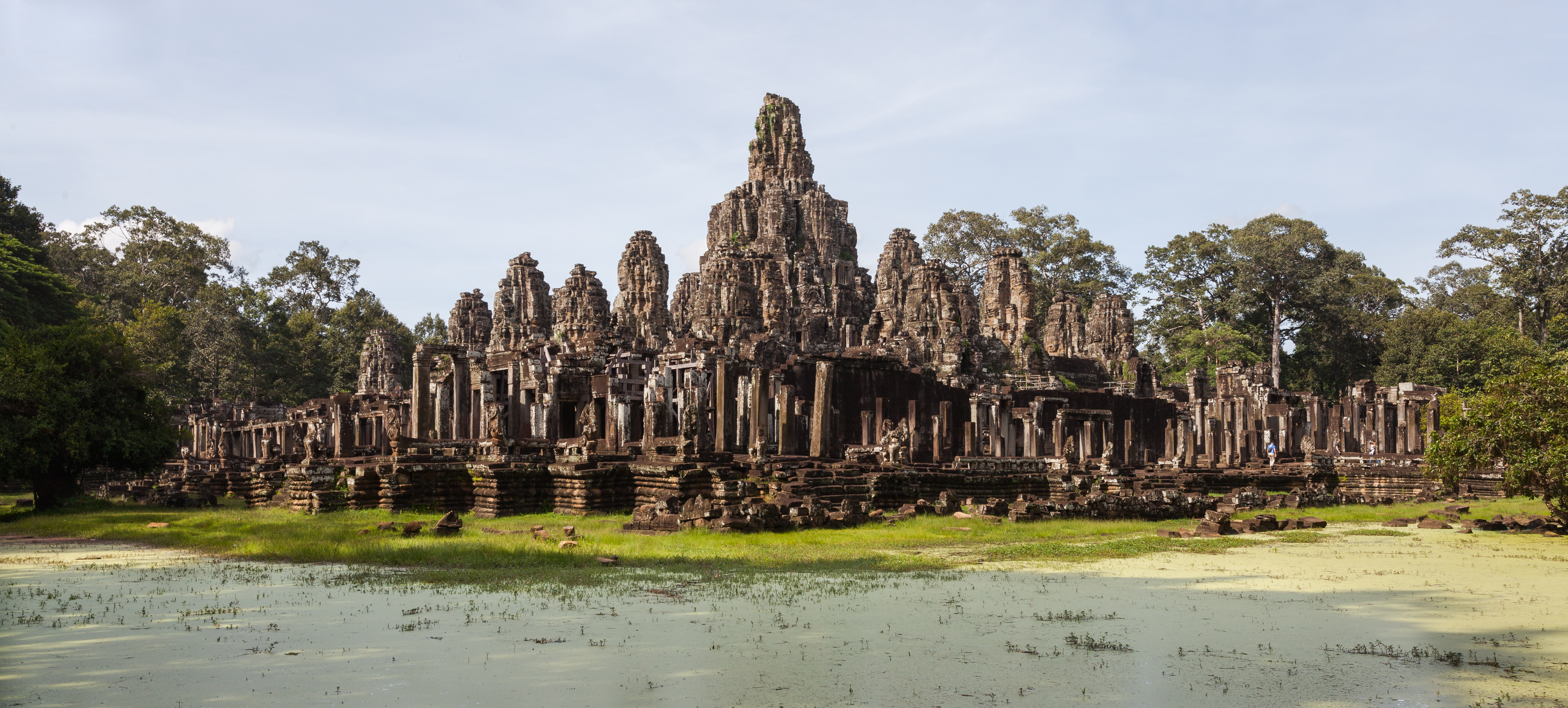
a day or two before. It is called Bayon. It surprised me because it had not the
uniformity of the other temples I had seen. It consists of a multitude of
towers one above the other, symmetrically arranged, and each tower is a
four-faced, gigantic head of Siva the Destroyer. They stand in circles one
within the other and the four faces of the god are surmounted by a decorated
crown. In the middle is a great tower with face rising above face till the apex
is reached. It is all battered by time and weather, creepers and parasitic
shrubs grow all about, so that at a first glance you see only a shapeless mass
and it is only when you look a little more closely that these silent, heavy,
impassive faces loom out at you from the rugged stone. Then they are all around
you. They face you, they are at your side, they are behind you, and you are
watched by a thousand unseeing eyes. They seem to look at you from the remote
distance of primeval time and all about you the jungle grows fiercely. You
cannot wonder that the peasants when they pass should break into loud song in
order to frighten away the spirits; for towards evening the silence is
unearthly and the effect of all those serene and yet malevolent faces is eerie.
When the night falls the faces sink away into the stones and you have nothing but
a strange, shrouded collection of oddly shaped turrets.
But it is not on account of the temple itself that I
have described it – I have, albeit with a halting pen, already described more
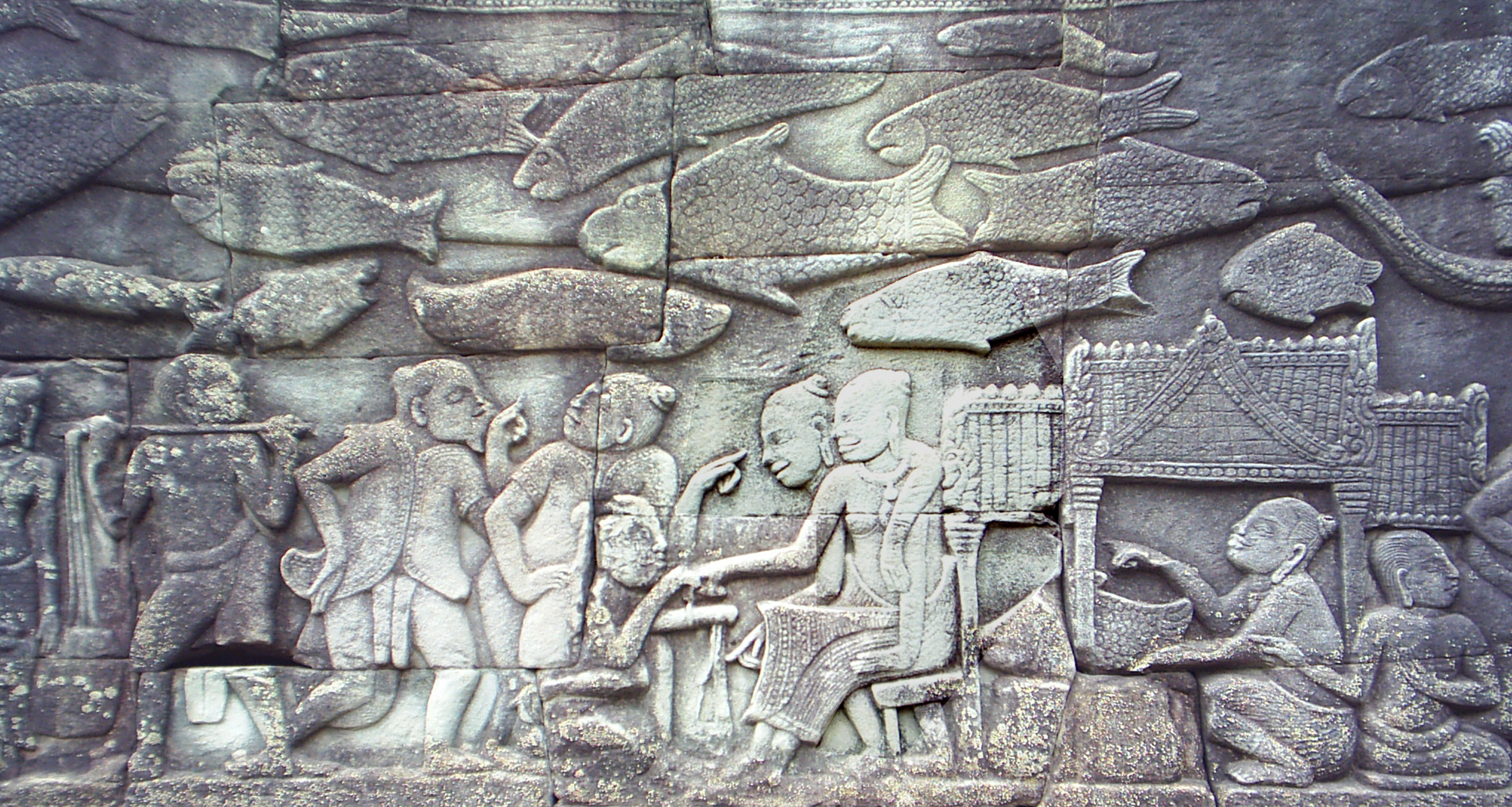
than enough – it is for the sake of the bas-reliefs that line one of its
corridors. They are not very well done, and the sculptors had but too obviously
little sense of form or line, but they have notwithstanding an interest which
at this moment called them up vividly to my memory. For they represent scenes
in the common life of the day in which they were done, the preparation of rice
for the pot, the cooking of food, the catching of fish and the snaring of birds,
the buying and selling at the village shop, the visit to the doctor, and in
short the various activities of a simple people. It was startling to discover
how little in a thousand years this life of theirs had changed. They still do
the same things with the same utensils. The rice is pounded or husked in the
self-same way and the village shopkeeper on the same tray offers for sale the
same bananas and the same sugar cane. These patient industrious folk carry the
same burdens on the same yokes as their ancestors carried so many generations
back. The centuries have passed leaving no trace upon them, and some sleeper of
the tenth century awakening now in one of these Cambodian villages would find
himself at home in the artless round of daily life.
Then it seemed to me that in these countries of the
East the most impressive, the most awe-inspiring monument of antiquity is
neither temple, nor citadel, nor great wall, but man. The peasant with his
immemorial usages belongs to an age far more ancient than Angkor Wat, the great
wall of China, or the Pyramids of Egypt.
 |
| Siva heads at the Bayon Temple, Angkor, Cambodia. Photo by Hans Stieglitz [CC BY-SA 3.0.] |
 |
| The Bayon Temple, bas-relief of a market scene from the souther gallery. From Wikimedia Commons, GNU Free Documentation License. |
[Chapter XL:]
But there are places of which the only point is the
arrival; they promise the most fantastic adventures of the spirit and give you
no more than three meals a day and last year’s films. They are like a face,
full of character that intrigues and excites you, but that on closer
acquaintance you discover is merely the mask of a vulgar soul. Such is Tourane .
I spent one morning there in order to visit the
museum in which there is a collection of Khmer sculpture. The reader may
possibly remember that when I wrote of Phnom-Penh I became strangely eloquent
(for a person who does not much like others to gush and is shy of superlatives)
about a statue to be seen there. This was a Khmer work and now I may remind him
(or tell him if like me till I went to Indo-China he never knew that Khmers or
their sculpture existed) that this was a mighty nation, the offspring of the
aboriginal tribes of Indo-China and an invading race from the plateaux of Central
Asia, who founded a far-flung and powerful empire. Immigrants from Eastern India brought them the Sanskrit language,
Brahmanism and the culture of their native land; but the Khmers were vigorous
people and they had a creative instinct that enabled them to make their own use
of the knowledge the strangers brought them. They built magnificent temples and
adorned them with sculptures, founded it is true on the art of India, but which
have at their best an energy, a boldness of execution, a fertility and a brilliant
fancy to be found nowhere else in the East. The statue of Harihara at
Phnom-Penh testifies to the greatness of their genius. […] It has the candour
of the primitive quickened by the complexity of the civilised. The Khmer
brought a long inheritance of thought to the craft which had so suddenly
captivated his fancy. It is as though to the England of the Elizabethan age had
come, a bolt from the blue, the art of painting in oil; and the artists, their
souls charged with the plays of Shakespeare, the conflict of religions at the
Reformation, and the Armada, had begun to paint with the hand of Cimabue. Something
like this must have been the state of mind of the sculptor who made the statue in
Phnom-Penh. It has power and simplicity and an exquisite line, but it has also
a spiritual quality that is infinitely moving. It has not only beauty, but
intelligence.
These great works of the Khmers gain a peculiar
poignancy when you reflect that a few ruined temples strewn about the jungle
and a few mutilated statues scattered here and there in museums are all that
remains of this mighty empire and this restless people. Their power was broken,
they were dispersed, becoming drawers of water and hewers of wood, they died
out; and now, the rest of them assimilated by their conquerors, their name
endures only in the art they so lavishly produced.
[Chapter XLI:]
The French carry France
to their colonies just as the English carry England Paris is the centre
of the world, and the ambition of every young Annamite is to see it at least
once in his life; you will hardly meet one who is not convinced that outside France
[Chapter XLIV]
[Last lines:]
‘Tell me,’ I said now, ‘you must have known an awful
lot of people, what opinion have you formed of the human race?’
‘Sure I’ll tell you. I think they’re bully. You’d be
surprised at the kindness I’ve received from everybody. If you’re ill or
anythin’ like that, perfect strangers will nurse you like your own mother. White,
yellow, or brown, they’re all alike. It’s surprisin’ what they’ll do for you. But
they’re stupid, they’re terribly stupid. They’ve got no more brains than a
turnip. They can’t even tell you the way in their own home town. I’ll give you
my opinion of the human race in a nutshell, brother; their heart’s in the right
place, but their head’s a thoroughly inefficient organ.’
This really is the end of this book.

No comments:
Post a Comment